Flexible gradient-array thermal metamaterials for scalable conformal heat-flux control
Abstract
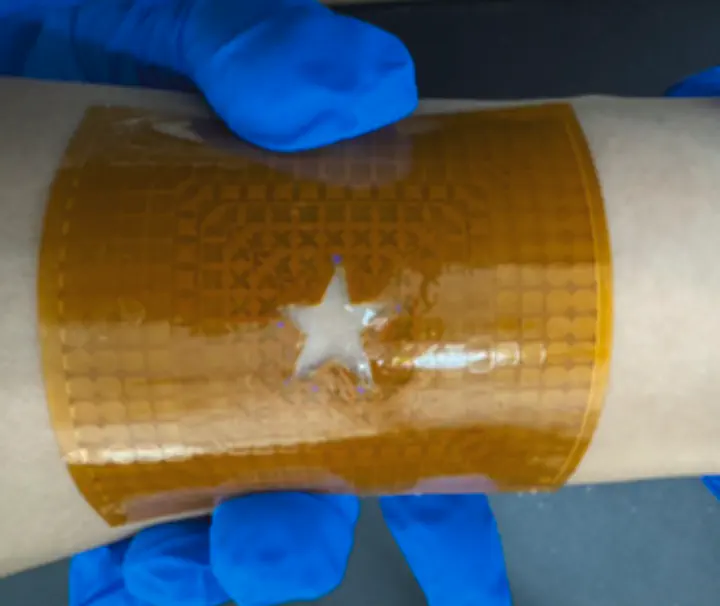
The integration of multifunctional modules into ultrathin, spatially constrained flexible electronics often leads to localized heat accumulation, challenging device reliability under conformal operation. Achieving precise heat-flux manipulation, mechanical flexibility, and scalable fabrication within a unified platform remains an open challenge. Here, we report a gradient-discretized design strategy for flexible thermal metamaterials that combines multiscale topology optimization with transformation thermotics. This framework links microstructural geometry, deformation-induced effects, and macroscopic thermal functionality, including thermal cloaking and thermal concentration. Using flexible printed-circuit fabrication, we fabricate gradient arrays containing 6×6 to 20×20 unit cells, with pitches ranging from 10 to 3 mm, within a fixed 60×60 mm² footprint. We also develop a coupled thermomechanical resistance model to quantify bending-induced perturbations. In the flat state, the thermal-cloaking function suppresses the temperature gradient within the protected region to approximately 1% of the surrounding background gradient, thereby enabling thermal concealment of embedded heterogeneous structures. The thermal-concentration function enhances local heat focusing by nearly one order of magnitude, increasing the temperature difference available to a thermoelectric module. Both functions remain effective under bending at a radius of 19 mm, with only moderate performance degradation. These results establish a scalable and mechanically compliant platform for programmable heat-flux control in next-generation conformal and wearable electronics.