Airy beams for radiative near-field communications: Fundamentals, potentials, and limitations
Abstract
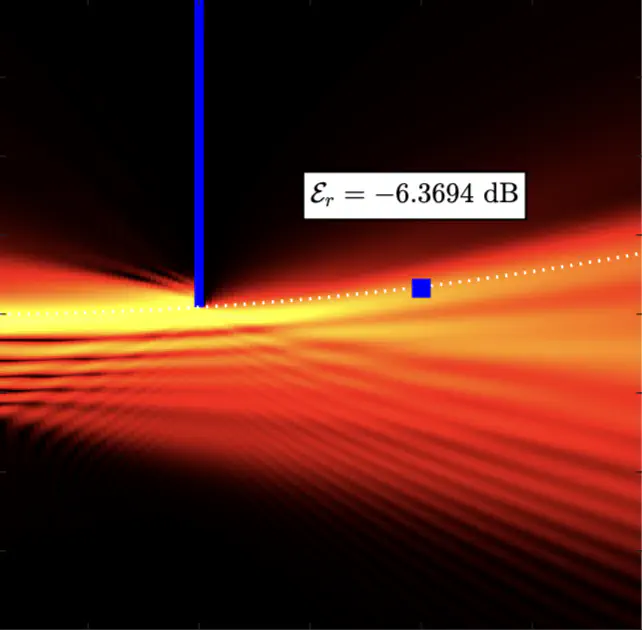
In next-generation wireless networks, electromagnetic signals are envisioned to be radiated from large-scale radio-frequency transmitters operating in the millimeter-wave and sub-terahertz bands. The combination of electrically large radiating apertures and high-frequency transmission extends the radiative near-field region around the transmitter. In this region, unlike in the far field, the wavefront is nonplanar, which provides additional degrees of freedom to shape and steer the transmitted beam as desired. In this paper, we focus on Airy beams, which may exhibit several highly desirable properties in the radiative near-field region. In their ideal form, these beams can follow self-accelerating (curved) trajectories, exhibit resilience to perturbations through self-healing, and maintain a shape-preserving intensity profile in a co-moving transverse frame, making them effectively diffraction-resistant. Specifically, starting from diffraction theory as the foundational propagation model for radiative near-field free-space beam manipulation, we first present the underlying principles of self-accelerating beams radiated by continuous aperture field distributions. We then address several challenges regarding the generation of Airy beams, including their exponential decay due to finite energy constraints and spatial truncation of the aperture. Moreover, we examine their free-space propagation characteristics, focusing on a generalized link budget formulation and a polychromatic representation. The second part of the paper focuses on the propagation behavior of Airy beams in non-line-of-sight (NLoS) scenarios, which are particularly relevant for radiative near-field wireless communication applications. We also present a comparison between Airy beams and Gaussian beams, which represent the most common solution for focused beam transmission in the near field, evaluating their performance in terms of received energy. Our theoretical and numerical results show that Airy beams may offer a performance advantage over Gaussian beams in certain NLoS channels, provided that their key properties are largely preserved, specifically, self-acceleration along a parabolic trajectory and diffraction-resistant propagation. In the presence of an obstacle, this requires that the portion of the transmit aperture with a clear line-of-sight to the receiver is sufficiently large. These findings underscore the intriguing potential of Airy beams in radiative near-field wireless links, while also highlighting the importance of a concurrent electromagnetic and telecommunication design to fully harness their advantages in practical systems.