Randomized space-time stacked intelligent metasurfaces for massive multiuser downlink connectivity
Abstract
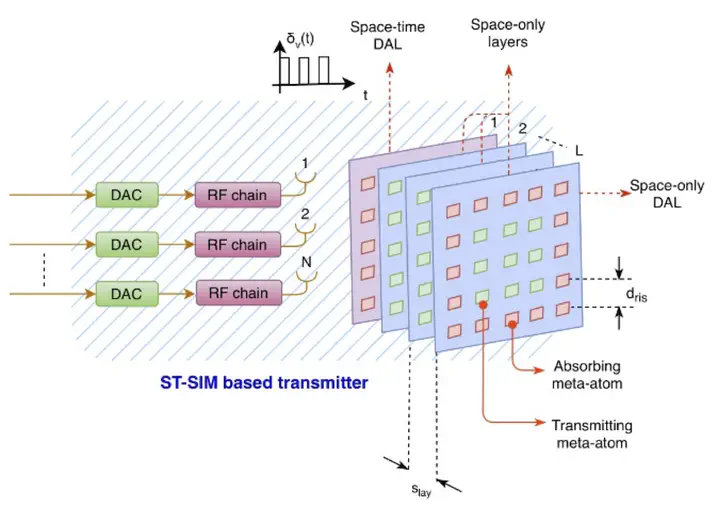
Stacked intelligent metasurfaces (SIMs) represent a key enabler for next-generation wireless networks, offering beamforming gains while significantly reducing the number of radio-frequency chains. In conventional space-only (S-only) SIM architectures, the rate of reconfigurability of the SIM is equal to the inverse of the channel coherence time. This paper investigates a novel beamforming strategy for massive downlink connectivity using a randomized space-time (ST) SIM. In addition to conventional S-only metasurface layers, the proposed design integrates an ST metasurface layer at the input stage of the SIM that introduces random variations over each channel coherence interval. These artificial time variations enable opportunistic user scheduling and exploitation of multiuser diversity under slow channel dynamics. To mitigate the prohibitive overhead associated with full channel state information at the transmitter (CSIT), we propose a partial-CSIT-based beamforming scheme that leverages randomized steering vectors and limited user-side feedback based on signal quality measurements. Numerical results demonstrate that the proposed ST-SIM architecture achieves satisfactory sum-rate performance while significantly reducing CSIT acquisition and feedback overhead, thereby enabling scalable downlink connectivity in dense networks..